Introduction
Headlines regularly report odds like "1 in 17.72 million for SSQ" or "1 in 292 million for Powerball." But to human intuition, millions and billions blend into abstract huge numbers. To ground these astronomical odds, here are 10 real-world probability analogies that make the near-impossibility of winning crystal clear.
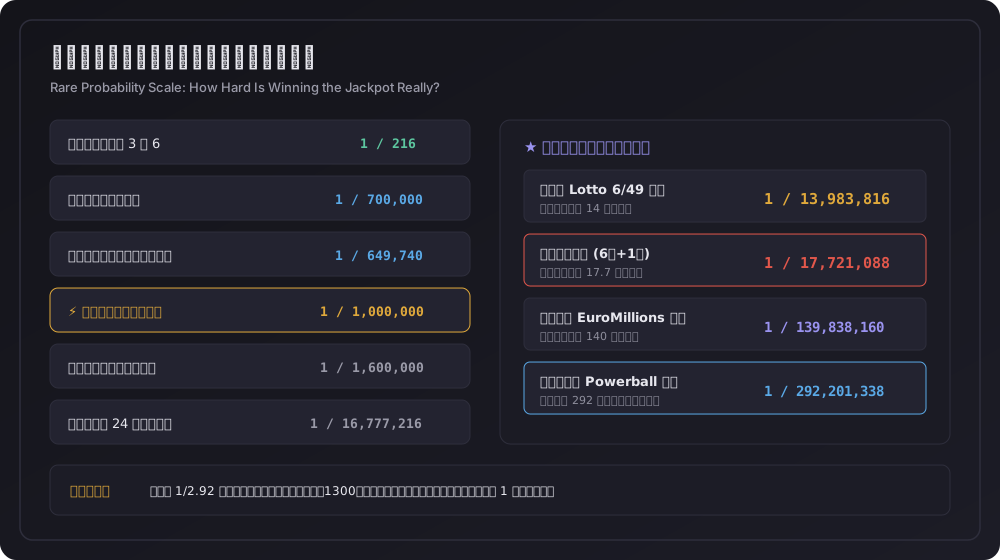
1. Rare Real-World Events vs Lottery Jackpots
Based on actuarial statistics from the US National Weather Service, CDC, and insurance tables, here is how daily life compares to lottery jackpots:
| Event | Odds (1 in) | Perspective |
|---|---|---|
| Rolling three consecutive 6s on dice | 1 / 216 | Everyday casino probability |
| Hit by falling objects in a year | 1 / 40,000 | Rare misfortune |
| Dealt a Royal Flush in Texas Hold’em | 1 / 649,740 | Ultimate poker legend |
| Identical quadruplets pregnancy | 1 / 700,000 | Medical miracle |
| ⚡ Struck by lightning in a lifetime | 1 / 1,000,000 | Extremely rare (1 in a million) |
| Hit by a falling meteorite fragment | 1 / 1,600,000 | Astronomical event |
| Flipping a coin heads 24 times consecutively | 1 / 16,777,216 | Near SSQ jackpot odds |
| 🔴 China SSQ Jackpot (6+1) | 1 / 17,721,088 | 17.7× harder than getting struck by lightning! |
| 🟣 EuroMillions Jackpot (5+2) | 1 / 139,838,160 | 140× harder than getting struck by lightning! |
| 🔵 US Powerball Jackpot (5+1) | 1 / 292,201,338 | 292× harder than getting struck by lightning! |
2. Three Mind-Boggling Visual Analogies
1. The Highway Pebble
Imagine driving on a 1,300 km (800 mile) highway from New York to Atlanta. One single 1 cm pebble marked with a tiny red dot is dropped along the shoulder. You are blindfolded, dropped at a random point along the highway, and reach down to grab one pebble. The chance of grabbing that exact pebble is equal to winning US Powerball (1 in 292 million).
2. The Olympic Swimming Pool of Rice
292 million grains of white rice weighs roughly 12 metric tons, filling an Olympic-sized swimming pool. Exactly one single grain is dyed red. Diving in blindfolded and picking that one red grain is what it takes to hit the Powerball.
3. Playing for 1,800 Lifetimes
If you buy a ticket for every draw (3 times a week) from age 18 to 78, you buy about 9,360 tickets in a lifetime. Against 1/17.72 million odds (SSQ), you would need to live 1,890 consecutive lives buying tickets non-stop just to average one jackpot.
3. Why Does Someone Always Seem to Win?
If winning is so unlikely, why is there a winner in the news almost every week?
Because while your individual odds are 1 in 292 million, 100 to 200 million tickets are sold collectively across the entire nation for a single draw. A jackpot being hit is a macro-level certainty, while you being the winner remains an individual micro-impossibility.