Introduction
“If I just keep playing, I will eventually win it all back” is a pervasive fallacy among lottery players. Mathematically, this defies fundamental probability theorems: the Law of Large Numbers and Expected Value. This article provides a clear mathematical demonstration of why negative-EV games guarantee financial depletion as volume increases.
1. Expected Value: Every Ticket Is Guaranteed Negative Yield
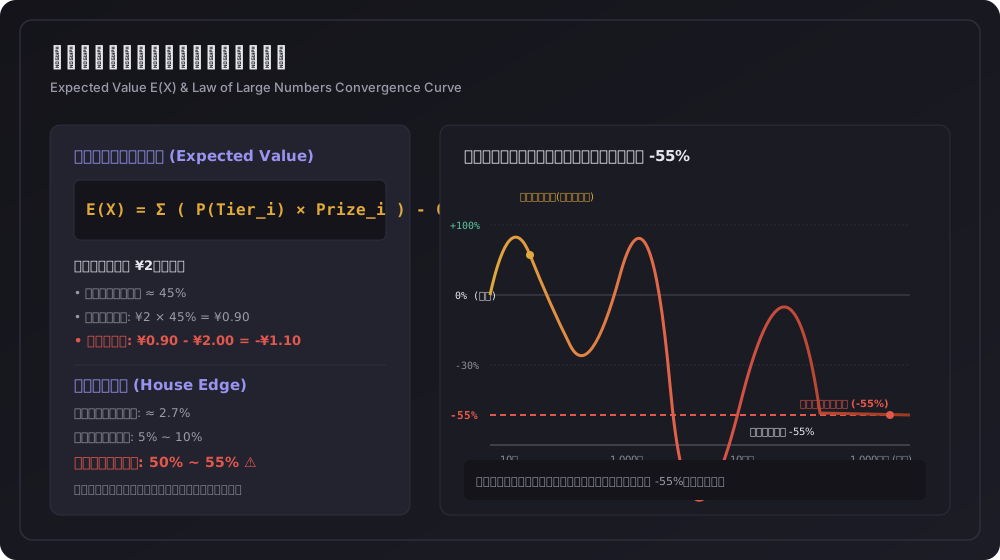
In probability theory, the expected value $E(X)$ of a discrete random variable measures the long-term average outcome of repeated trials:
E(X) = Σ (P(Tier_i) × Prize_i) - Cost
Take a standard $2 lottery ticket with a 50% legal payout model:
- Bottom tier prize (e.g. $4 on a 1/38 odds): expected value contribution ≈ $0.105
- Mid-tier prizes ($10 to $100): collective expected contribution ≈ $0.15
- Jackpot and high tiers (odds in 1/10M+): expected contribution ≈ $0.745
Total expected return per ticket = $1.00.
Your expected net outcome per $2 ticket is E(X) = $1.00 - $2.00 = -$1.00 (-50%). Mathematically, the very instant you buy a ticket, you have locked in a 50% loss on your capital.
2. The Law of Large Numbers: Eliminating Luck
Some might argue: “Someone won the jackpot on their first try — didn’t they beat math?”
That is short-term variance and survivorship bias. The Law of Large Numbers (LLN) dictates that as the number of trials $N$ grows, the sample mean strictly converges to the theoretical expected value:
lim (N → ∞) [Total Winnings / Total Spent] = -50% (or -55%)
Buy 1 ticket, and variance dominates. Buy tickets over 40 years, and the Law of Large Numbers completely crushes variance: your bankroll steadily decays toward the predetermined -50% return rate.
3. Gambler’s Ruin Theorem
Gambler's Ruin theorem proves that a player with finite wealth playing a game with negative expected value against an entity with near-infinite reserves (the state lottery) will go broke with a probability of 1.0 (100%).
Our interactive Powerball Simulator demonstrates this reality: thousands of simulated lifetimes prove that even over hundreds of thousands of draws, virtually 100% of participants experience steady bankruptcy.